
Online security services for retailers range from $50 to $200+ per user per month, with total investment driven by your endpoint count, compliance obligations, cloud architecture complexity, and whether you need 24/7 monitoring. The right choice depends less on feature checklists and more on aligning service scope with your actual risk profile and operational maturity.
Canada’s managed security services market tells the story of urgency: valued at $3.24 billion in 2025 and projected to reach $5.19 billion by 2030, this 9.8% annual growth reflects retailers confronting a threat landscape that outpaces internal capacity. For online merchants, the calculus is straightforward. Payment card breaches, ransomware incidents, and regulatory penalties carry costs that dwarf prevention budgets, yet most retailers lack the in-house expertise to operate enterprise-grade defenses around the clock.
The challenge isn’t recognizing the need for security services. It’s cutting through marketing claims to identify what you’re actually buying, understanding which capabilities justify premium pricing, and avoiding contracts that lock you into tools mismatched to your infrastructure. A managed detection and response platform suited for a distributed enterprise won’t serve a mid-sized direct-to-consumer brand the same way, and the pricing structures differ accordingly.
This guide breaks down service categories by function and deployment model, examines the cost drivers that separate $50 basic monitoring from $200+ comprehensive programs, and provides segment-specific buying criteria for small, mid-market, and enterprise retailers. You’ll learn which mistakes inflate costs without improving protection, how compliance requirements shape service selection, and what questions separate vendors offering genuine capability from those repackaging commodity tools.
The goal is simple: equip you to evaluate vendors on merit, budget realistically, and purchase services that address your specific vulnerabilities while respecting both consumer online protections and operational constraints. Security spending should reduce risk, not create new dependencies on overpriced or ill-fitting solutions.
Understanding Online Security Services: What Retailers Need to Know

Online security services for retailers extend far beyond basic antivirus software or firewalls. These specialized offerings protect the entire digital infrastructure that keeps an e-commerce operation running: payment processing systems, customer databases, inventory management platforms, and the web applications that connect them all. For retailers handling thousands of transactions daily, a breach doesn’t just mean stolen data, it means lost revenue, regulatory fines, and damaged customer trust that can take years to rebuild.
Managed Security Service Providers (MSSPs) deliver the most comprehensive protection by outsourcing security operations to dedicated experts. Rather than maintaining an in-house security team, which costs significantly more and requires constant training, retailers contract with MSSPs for continuous monitoring, threat detection, and incident response. These providers watch for suspicious activity around the clock, analyze emerging threats specific to retail environments, and respond immediately when attacks occur. The trade-off is clear: retailers gain enterprise-grade security without the overhead of building it themselves.
The scope of MSSP protection typically covers payment gateway security, customer personally identifiable information (PII), backend inventory systems, and the APIs that connect your storefront to logistics partners and payment processors. They manage firewall configurations, monitor for data exfiltration attempts, scan for vulnerabilities in your web applications, and ensure your systems meet Payment Card Industry Data Security Standard (PCI DSS) requirements.
Off-the-shelf security products fall short for e-commerce operations because retail environments are uniquely complex. A transaction touches multiple systems in milliseconds, storefront, payment processor, inventory database, shipping integration, and each connection point creates potential exposure. Pre-packaged software secures individual components but doesn’t account for how those components interact, leaving gaps that attackers exploit. Retailers need coordinated protection across their entire technology stack, which is precisely what managed services provide through integrated monitoring and response.
Types of Online Security Services for Retail Businesses

Managed Security Service Providers (MSSPs)
Managed Security Service Providers deliver outsourced cybersecurity operations tailored to a retailer’s infrastructure and risk profile. At their core, MSSPs handle continuous network monitoring, log analysis, and threat hunting across your e-commerce environment. They deploy security operations center (SOC) teams that watch for anomalies in payment gateways, customer databases, and inventory systems around the clock. When threats emerge, the provider’s incident response team investigates, contains the attack, and coordinates remediation, often faster than an internal team could react.
The scope of MSSP coverage varies significantly. Entry-level packages might monitor firewall logs and send alerts, leaving you to handle the response. Comprehensive programs include endpoint protection management, vulnerability scanning, patch coordination, and proactive threat intelligence that identifies emerging retail-specific attack patterns before they reach your systems. Some MSSPs specialize in compliance support, helping you maintain PCI DSS requirements through regular audits and policy enforcement.
What drives value for retailers depends on transaction volume and data sensitivity. Small merchants processing under 20,000 card transactions annually can often start with basic monitoring and reactive support. Mid-market retailers handling 100,000+ transactions benefit from 24/7 SOC coverage and dedicated analysts who understand retail attack vectors like credential stuffing and skimming. Enterprise operations need full-spectrum services that integrate with multi-cloud architectures and provide real-time visibility across distributed infrastructure.
Pricing typically ranges from $50 to $200+ per user monthly, influenced by the number of protected endpoints, compliance demands, and whether you need constant coverage or business-hours support.
Web Application and API Security Solutions
Web application firewalls and API security solutions protect the digital storefronts and backend systems where retailers conduct business. Unlike broad network monitoring, these services focus on the attack surface customers and integrations interact with directly: shopping cart interfaces, mobile apps, payment gateways, and third-party API connections that power inventory feeds, shipping calculators, and loyalty programs.
Modern WAF services defend against injection attacks, cross-site scripting, and automated credential stuffing that target login pages and checkout flows. They inspect HTTP traffic in real time, blocking malicious requests before they reach your application code. For retailers, this means protection at the point of transaction where revenue and customer trust are most vulnerable.
API security addresses a different threat landscape. As retail operations integrate more external services, payment processors, fraud detection platforms, marketing tools, each API endpoint becomes a potential entry point. API-specific protection monitors authentication mechanisms, rate-limiting abuse, and unusual data access patterns that signal compromised credentials or account takeover attempts.
Bot management is a critical component most providers bundle with WAF services. Retailers face inventory hoarding bots during product drops, price-scraping competitors, and fake account creation at scale. Effective bot protection distinguishes legitimate customers from automated traffic without adding friction to the checkout experience, using behavioral analysis rather than simple CAPTCHA challenges that frustrate real buyers.
Payment Security and Compliance Services
Payment-specific security services address the specialized requirements of handling customer transaction data. PCI DSS compliance solutions form the backbone of this category, providing the frameworks, tools, and documentation retailers need to meet Payment Card Industry standards. These services typically include quarterly vulnerability scans, annual penetration testing, policy templates, and remediation guidance, requirements that often surprise retailers new to card acceptance.
Tokenization services replace sensitive card data with non-sensitive substitutes, reducing the scope of PCI compliance audits and limiting exposure if a breach occurs. When implemented correctly, tokenization means card numbers never touch your primary systems, dramatically lowering both risk and compliance overhead.
Payment-specific security programs often bundle multiple protections: fraud detection algorithms that flag suspicious transactions in real time, encryption for data in transit and at rest, and secure payment gateway integrations that isolate transaction processing from your broader infrastructure. Many providers offer managed compliance services where they handle the ongoing validation work, filing Self-Assessment Questionnaires, coordinating assessments, and maintaining audit trails.
The real value lies in expertise. Payment security vendors understand merchant level classifications, know which controls apply to your transaction volume, and can translate compliance jargon into actionable technical requirements. They also stay current as standards evolve, sparing you the burden of tracking regulatory changes while running your retail operation.
Key Buying Factors: What to Evaluate Before You Choose
Pricing Models and Cost Drivers
Most online security service providers price their managed offerings on a per-user, per-month basis, and retailers should expect to budget between $50 and $200 per user monthly depending on coverage depth and business requirements. This wide range reflects real differences in service scope, basic monitoring at the lower end, comprehensive 24/7 threat detection and incident response at the upper end, so understanding what drives costs helps you evaluate whether a quoted price represents good value or a mismatch with your needs.
Several factors directly impact your monthly security services bill:
- Number of users requiring access and protection across your retail systems
- Total endpoint count including point-of-sale devices, inventory management terminals, and employee workstations
- Compliance mandates such as PCI DSS validation, which require documented controls and audit support
- Cloud environment complexity, especially multi-cloud or hybrid architectures that expand the attack surface
- Monitoring hours, business-hours coverage costs less than round-the-clock surveillance
- Incident response service level agreements guaranteeing faster response times and dedicated support
Retailers processing high transaction volumes or handling sensitive customer data typically land toward the higher end of the pricing spectrum because they need more robust monitoring, faster incident response, and stricter compliance documentation. A small retailer with ten employees and a single e-commerce platform might pay $600 monthly for adequate MSSP coverage, while a mid-market operation with fifty users, multiple cloud integrations, and PCI DSS requirements could easily spend $7,500 or more. Don’t anchor to the lowest advertised rate without confirming it covers your compliance obligations and actual endpoint count, underbuying security to save money today often leads to expensive gaps tomorrow.
Compliance Requirements and Certification Support
Compliance requirements drive both service selection and ongoing costs, yet many retailers underestimate the complexity involved. For online businesses handling payment card data, PCI DSS compliance isn’t optional, it’s a contractual obligation imposed by payment processors and card brands. The question isn’t whether you need it, but whether your security provider can actually deliver and maintain it.
When evaluating providers, ask specifically how they support your compliance validation level. Most small to mid-size retailers fall under PCI DSS Level 3 or 4, requiring annual Self-Assessment Questionnaires (SAQs) rather than full audits. A capable provider should help you achieve SAQ A or SAQ A-EP status by handling card data processing outside your environment, dramatically reducing your compliance scope. They should also provide quarterly vulnerability scans from an Approved Scanning Vendor (ASV), documentation support for your SAQ submission, and clear evidence of their own PCI compliance status.
Compliance isn’t a one-time checkbox. Standards evolve, vulnerabilities emerge, and your business changes. Look for providers who offer continuous compliance monitoring, automatic policy updates when standards change, and regular reporting that demonstrates ongoing adherence. The service agreement should specify who owns which compliance responsibilities, some providers assume full payment security compliance, while others simply provide tools you must configure correctly.
Also consider region-specific requirements. Canadian retailers may need to address PIPEDA for personal data protection, while those selling internationally face GDPR or other regulations. A provider experienced in multi-jurisdictional compliance can prevent costly gaps as your business expands.
Coverage Scope and Service Level Agreements

Coverage depth varies dramatically between providers, and the service level agreement tells you exactly what you’re buying. Some retailers discover only after an incident that “managed security” meant weekday monitoring with email alerts, not the round-the-clock protection they assumed.
True 24/7 monitoring means security analysts are actively watching your environment every hour of every day, including holidays. Business-hours coverage may cost less, but attacks don’t pause at 5 p.m. or wait until Monday morning. For e-commerce operations processing transactions around the clock, weekend and overnight gaps create windows of vulnerability that threat actors routinely exploit.
Response time commitments matter as much as monitoring hours. Your SLA should specify how quickly the provider acknowledges critical alerts (typically 15-30 minutes for high-severity threats), begins investigation, and escalates to your team. Generic promises of “rapid response” mean nothing without contractual timeframes tied to severity levels.
Threat intelligence integration distinguishes reactive services from proactive ones. Better providers ingest real-time threat feeds, correlate attack patterns across their client base, and apply that intelligence to your defenses before threats reach you. Ask what intelligence sources they use and how quickly new threat signatures reach your environment.
“Managed” itself is an elastic term. Some providers handle monitoring and alerting but leave remediation to you. Others execute containment, patching, and recovery as part of base service. Clarify what actions the provider takes automatically, what requires your approval, and where responsibility transfers back to your team. The SLA should map these boundaries explicitly, so there’s no confusion during an active incident.
Scalability and Cloud Compatibility
Your security service must expand alongside your retail operation without requiring a complete overhaul every time you add a new sales channel or cloud platform. Scalability means the service accommodates increasing transaction volumes, additional storefronts, and seasonal traffic spikes without degrading protection or requiring manual reconfiguration.
Cloud compatibility is equally critical. Many retailers run hybrid environments, some infrastructure on-premises, customer-facing applications in AWS or Azure, payment processing through specialized platforms. Your security provider needs native integrations with these environments, not bolt-on workarounds that create gaps. Ask whether the service supports multi-cloud monitoring, whether agent deployment scales automatically, and how quickly new infrastructure gets protected after provisioning.
Integration with your existing retail stack matters more than most retailers initially realize. Security services that don’t connect cleanly with your e-commerce platform, inventory management system, and customer data tools create friction and visibility gaps. Evaluate whether the provider offers APIs for your specific platforms, how updates are handled across environments, and whether you’ll need separate consoles for different parts of your infrastructure. The best services grow transparently with your business rather than forcing you to adapt your operations to their limitations.
Market Context: The Growth of Security Services in 2026
The managed security services market is experiencing significant growth, and that expansion matters for retailers evaluating providers. The Canada MSS market was valued at $3,248.2 million in 2025 and is projected to reach $5,191.3 million by 2030, reflecting a compound annual growth rate of 9.8%. This isn’t just a regional trend, it signals widespread enterprise recognition that security demands specialized expertise and continuous monitoring.
For retailers, this market maturity translates into tangible benefits. As the sector grows, provider offerings become more standardized and transparent. Competition drives innovation in service delivery, threat detection capabilities, and pricing models. You’re entering a market where vendors have refined their approaches through thousands of client deployments, not experimenting with untested frameworks.
The growth also indicates that businesses across industries are shifting security from internal IT functions to specialized partners. This validates the managed services approach: companies recognize they can’t maintain the depth of expertise, 24/7 staffing, and threat intelligence infrastructure that dedicated providers deliver. For retailers weighing the build-versus-buy decision, the trajectory is clear, organizations are increasingly choosing to buy.
That said, a growing market means more providers competing for your business. Some will overpromise on coverage or underdeliver on response quality. The vendor landscape includes established players with proven retail experience and newer entrants still developing their service maturity. Market growth creates opportunity, but it also demands careful vetting of provider track records and contract commitments.
How to Match Security Services to Your Retail Operation
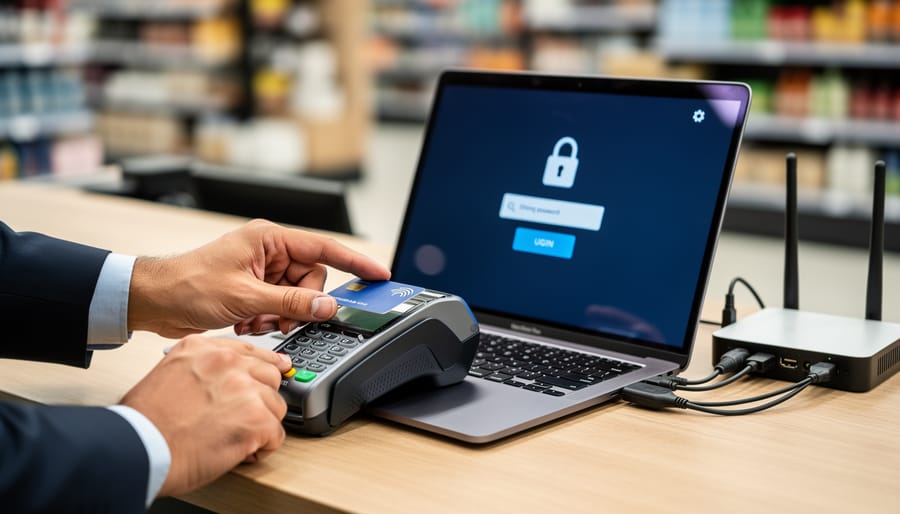
Matching the right security service to your retail operation starts with an honest assessment of three factors: transaction volume, the sensitivity of data you handle, and your actual risk exposure. A boutique online store processing 100 orders monthly faces different threats than a mid-sized retailer managing 10,000 transactions, and both operate in a different security universe than an enterprise platform handling millions of checkouts. The service tier that protects one adequately will either overwhelm or leave gaps in another.
Small retailers, typically under 50 employees with limited IT staff, benefit most from integrated platform solutions that bundle essential protections without requiring deep security expertise to manage. Look for providers offering basic PCI DSS compliance support, automated threat monitoring, and straightforward pricing based on transaction volume rather than per-user licensing. At this scale, expect to invest $500 to $2,000 monthly for meaningful coverage that includes web application firewall protection and basic incident response. Avoid overbuying enterprise-grade threat intelligence you lack the resources to act on; focus instead on services that prevent common attacks targeting small e-commerce sites and provide clear guidance when incidents occur.
Mid-market operations face the challenging middle ground: large enough to attract sophisticated attacks but often lacking the security teams of enterprise competitors. This segment, typically 50 to 500 employees, should prioritize MSSPs that offer 24/7 monitoring with defined response protocols and compliance validation services. Your buying criteria shift toward scalability and cloud compatibility as you likely operate across multiple platforms and process customer data subject to regulatory scrutiny. Budget $3,000 to $15,000 monthly depending on transaction complexity and compliance requirements, pricing in this range typically reflects per-user models ($50 to $150 per user monthly) covering endpoints, cloud workloads, and payment infrastructure. Ensure any provider understands consumer rights frameworks and can demonstrate how their services help you meet obligations around data breach notification and customer protection.
Enterprise retailers processing high transaction volumes need comprehensive managed security with dedicated support, advanced threat intelligence, and the capacity to defend complex, distributed infrastructure. At this scale, typically 500-plus employees with global operations, you’re evaluating providers on incident response speed, integration with existing security operations centers, and their track record handling retail-specific attack vectors like credential stuffing and API abuse. Enterprise contracts often exceed $20,000 monthly and may approach $200-plus per user when covering extensive endpoint counts, multi-cloud environments, and specialized compliance requirements across jurisdictions.
The most critical matching factor across all segments: ensure the provider’s service delivery model aligns with your internal capabilities. A hands-off retailer needs more managed response and remediation; a retailer with in-house IT can focus spending on monitoring and threat intelligence rather than full incident management.
Common Mistakes Retailers Make When Buying Security Services

Retailers consistently trip over the same security service pitfalls, often discovering their mistakes only after a breach exposes the gaps. The most common error is treating security as a pure cost center and defaulting to the cheapest option without evaluating coverage adequacy. A retailer processing 10,000 transactions daily who selects a basic monitoring package to save $80 per month may find their service lacks the API protection, bot management, and payment fraud detection their storefront actually requires. When an attack exploits these blind spots, the cost of recovery, regulatory fines, and customer trust erosion dwarfs the savings from budget-tier protection.
Another critical mistake is underestimating PCI DSS compliance complexity and assuming any security service automatically delivers certification support. Compliance requires specific validation procedures, documentation workflows, and continuous monitoring controls that not all MSSPs provide. Retailers who discover their $75-per-user service doesn’t include quarterly scans or help with attestation forms face scrambling to meet merchant agreement deadlines or paying separately for compliance consultants they thought were included.
Failing to assess incident response capabilities before signing represents a dangerous oversight. Many retailers focus on preventive controls during vendor evaluation but never ask how the provider handles active breaches. What’s the escalation path when suspicious activity is detected at 2 a.m.? Who leads forensic investigation? How quickly can the team isolate compromised systems? Without a clear defense strategy that includes rapid containment procedures, retailers face extended downtimes and expanded breach scope when incidents occur.
Ignoring cloud-specific requirements is increasingly problematic as retail infrastructure shifts to SaaS platforms and cloud-hosted environments. Retailers running Shopify, BigCommerce, or custom cloud stacks need services that monitor API calls, serverless functions, and third-party integrations, not just traditional network perimeters. Selecting a provider without proven cloud visibility leaves modern attack surfaces undefended.
Finally, retailers overlook contract flexibility as business needs evolve. Rigid multi-year agreements with fixed user counts and no scalability provisions become liabilities when transaction volume spikes, new store locations open, or acquisition changes the security landscape. Before committing, confirm how the contract handles growth, seasonal fluctuations, and exit terms if you need to switch providers.
Main Options Compared
Retailers shopping for online security face three primary service models, each with distinct trade-offs. Managed security service providers (MSSPs) deliver 24/7 monitoring, threat detection, and incident response at typical costs of $50, $200+ per user per month depending on coverage scope and compliance requirements. This full-service approach suits retailers handling sensitive payment data or lacking in-house security expertise, though ongoing fees reflect continuous staffing and technology updates.
Platform-integrated security solutions bundled with e-commerce or payment processors offer convenience and tighter integration with transaction flows. These services typically include baseline protections like fraud screening and basic firewalls but may not provide the depth needed to prevent ransomware or sophisticated attacks targeting inventory systems and customer databases.
Point solutions such as standalone web application firewalls or PCI compliance services address specific security gaps without full managed oversight. Retailers often combine multiple point solutions when they need targeted protection or already have internal IT teams managing day-to-day security operations, accepting the coordination overhead in exchange for granular control and potentially lower costs than comprehensive MSSP contracts.
Frequently Asked Questions
What’s the difference between an MSSP and building in-house security?
An MSSP provides experienced security teams, 24/7 monitoring infrastructure, and threat intelligence that most retailers can’t economically replicate internally. In-house security requires hiring specialized staff, purchasing and maintaining tools, and keeping pace with evolving threats, investments that typically exceed $50, $200+ per user monthly for comparable MSSP coverage.
Do I really need 24/7 security monitoring for my online store?
Cyberattacks don’t observe business hours, and automated threats can compromise customer data or payment systems within minutes. If you process transactions, store payment card data, or handle customer accounts, continuous monitoring provides the rapid threat detection and response needed to prevent breaches that damage customer trust and trigger regulatory penalties.
How do I verify a security service meets PCI DSS requirements?
Ask potential providers for their Attestation of Compliance (AOC) or Service Organization Control (SOC) reports that document their security controls. Reputable services will clearly outline which PCI DSS responsibilities they handle versus those you retain, and they should support your validation process with documentation and audit assistance.
Can I switch security providers if my needs change or I’m unhappy?
Most managed security contracts run 12-36 months, though terms vary significantly. Before signing, clarify cancellation provisions, data portability requirements, and transition support, switching mid-contract often involves penalties, but flexible providers accommodate reasonable business changes and scaling needs.
What’s typically included in managed security services?
Standard MSSP packages cover threat monitoring, vulnerability scanning, log analysis, and incident alerting, while enhanced tiers add incident response, security tool management, compliance reporting, and forensic investigation. Pricing reflects coverage depth, with costs driven by the number of users, endpoints monitored, compliance requirements, and whether you need around-the-clock or business-hours support.
Should my team complete security training if we’re using a managed service?
Yes, even with external monitoring, your staff handle customer data, access systems, and respond to suspicious activity daily. Complementing managed services with information security training helps employees recognize phishing attempts, follow secure handling procedures, and respond appropriately when your MSSP flags potential threats.
These questions reflect the practical concerns retailers face when evaluating security services. Understanding the MSSP value proposition helps you assess whether outsourcing makes financial and operational sense compared to building internal capabilities. The 24/7 monitoring question addresses a common hesitation point where retailers underestimate attack timing and speed.
Compliance verification matters because PCI DSS responsibility ultimately rests with your business, regardless of which providers you engage. Knowing how to validate provider credentials prevents costly assumptions about coverage. Contract flexibility deserves attention upfront since retail needs shift with seasonal volume changes, expansion plans, and technology migrations that may require different security configurations.
Selecting the right online security services for your retail operation isn’t a checkbox exercise. It’s a strategic decision that balances immediate budget constraints against long-term operational needs and evolving threat landscapes. The most effective approach treats security as an ongoing partnership rather than a one-time purchase, recognizing that your requirements will shift as your business grows, regulations change, and attackers refine their tactics.
Throughout this guide, we’ve emphasized three core pillars: cost structure, compliance alignment, and coverage depth. These aren’t isolated factors. Your budget determines service scope, but skimping on coverage to save money often leads to costlier breaches down the line. Compliance requirements like PCI DSS aren’t optional hurdles but fundamental protections that shape which providers can actually serve your needs. And operational coverage, whether 24/7 monitoring, cloud compatibility, or incident response capabilities, defines how well a service protects your specific retail environment.
As you begin your evaluation process, start with an honest assessment of your current security posture and realistic projections for growth. Request detailed breakdowns of what drives pricing beyond the $50, $200 per user baseline, and ask providers to explain their response protocols in plain terms. Prioritize vendors who demonstrate transparency about service limitations and offer contract flexibility as your needs evolve.
The investment you make today sets the foundation for customer trust and operational resilience. Choose providers who view security as a partnership, not a product sale.